A single loop: A single loop of area A is placed in the stream, whose plane is perpendicular to the direction of the flow. Flux of the loop is the fluid volume passed through the loop per unit time.
Φ=v⋅A=vAcosθ
A closed area :
Φ=∑Φi=∑vi⋅Ai
A closed surface :
dA=dydzi+dxdzj+dxdyk,v=vxi+vyj+vzk
Φ=∬v⋅dA=∬vxdydz+vydxdz+vzdxdy
Src or Sink within
Φ
None
Φ=∬v⋅dA=0
Source
Φ=∬v⋅dA>0
Sink
Φ=∬v⋅dA<0
Flux of Electric Field/ Electric Flux
ΦE=∑E⋅A,ΦE=∬E⋅dA
The flux of electric field is the number of lines of electric field passing through the closed surface.
Specially, the integral over a closed surface is Electric Flux.
Note
Electric Flux is a scalar quantity.
dA is normal to the surface and points out of the surface. Sign matters a lot!
Physical meaning: Electric Flux is the sum of the normal components of the electric field all over the surface.
For an open surface, the direction of A could be determined in two different ways.
Gauss’ Law
∬E⋅dA=ΦE=ϵ0qenclosed
The net electric flux through any closed surface is proportional to the charge enclosed by that surface.
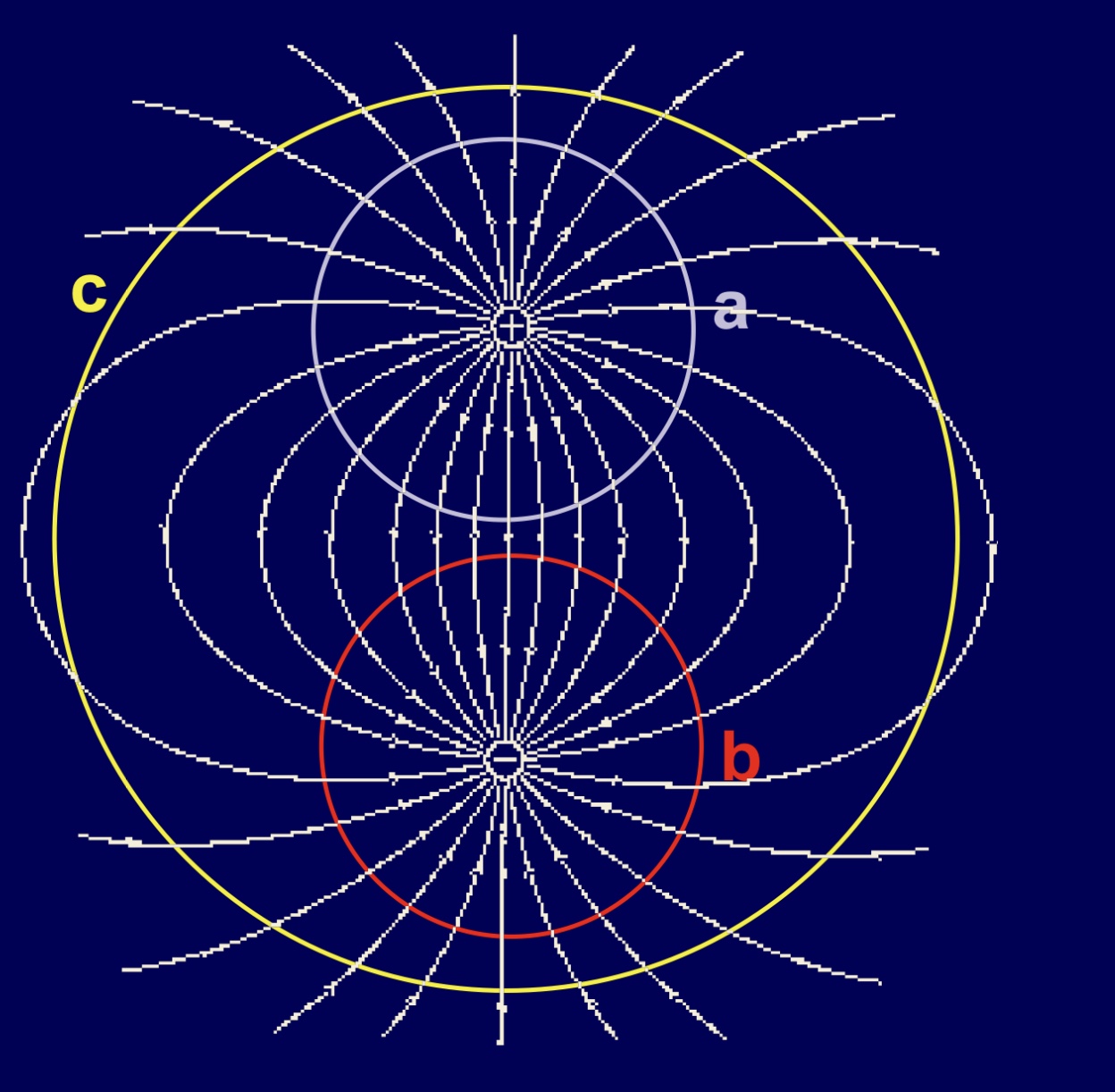
Example: Dipole
Fig
Point a
Point b
Point c
ϵ0∬E⋅dA=+q>0
ϵ0∬E⋅dA=0
ϵ0∬E⋅dA=−q<0
How to Use
Direction:
E⋅dA=EdA,ifE∥dA
E⋅dA=0,ifE⊥dA
Magnitude:E has same value everywhere.
With these two conditions, E could be brought out of the integral. i.e.E∬dA=ϵ0qenclosed.
NOTEE is the electric field generated by all charges (no matter within/without the closed surface), while Qenclosed just contains charges within the surface.
Calculating E by Gauss’
Uniform charged sphere
A solid sphere of radius a is of uniform charge density ρ . Calculate the electric field a point at distance r from the center of the sphere.
Outside sphere r>a:
∬EdA=4πr2E=ϵ0qenclosed=ϵ034πa3ρ
E=3ϵ0r2a3ρ
Inside sphere r<a:
∬EdA=4πr2E=ϵ0qenclosed=ϵ034πr3ρ
E=3ϵ0rρ
Conductors
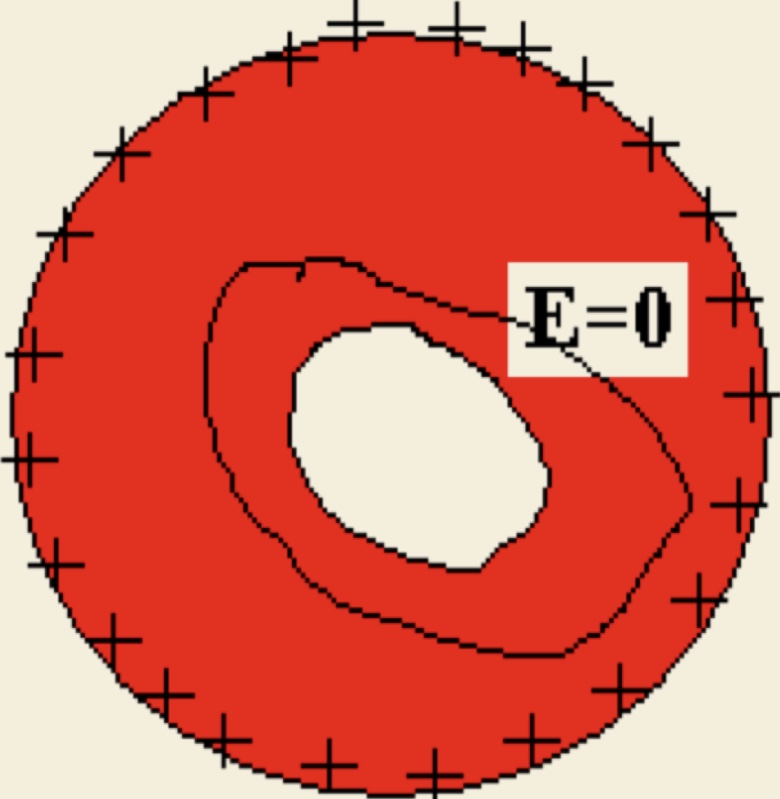
Inside the conductors, E=0. Therefore, Qinside=0, charges only reside on the surface.
isolated sphere
isolated conductor with cavity
charge in cavity
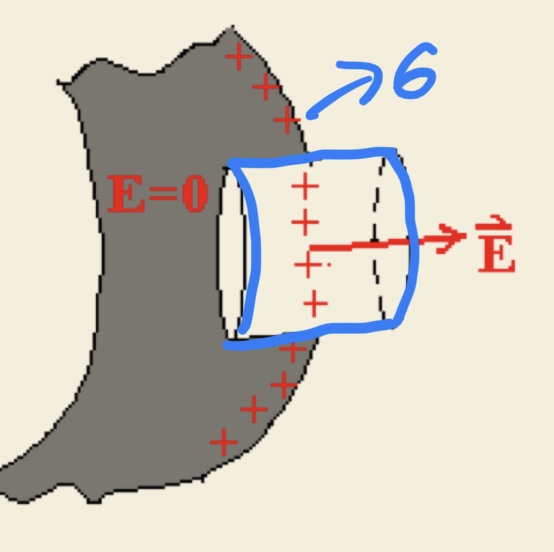
The outer E field:
ϵ0∬E⋅dA=ϵ0EΔA=σ⋅ΔA
E=ϵ0σ
Here σ is single sided compared to σ in the disk equation E=2ϵ0σ.
Infinite line of charge
Take a cylinder shell as the gaussian surface.
ϵ0∬E⋅dA=2ϵ0πrhE=λh
E=2πϵ0rλ
Infinite sheet of charge
Take a cylinder shell as the gaussian surface.
ϵ0∬E⋅dA=2ϵ0AE=σA
E=2ϵ0σ
Similarly, E fields between outside infinite sheets of σ charge density is 0. E fields between is ϵ0σ.
Summary For spherical, cylindrical, planar symmetry of electric fields, Gauss’ Law makes solving easy.